Comment: Can building technology really deliver meaningful returns in retail?

By James Hallworth, partner and head of building technology at Workman LLP
Building technology has long been embedded in the office sector. Metering, monitoring, and optimisation systems have been a standard part of institutional office management for years, with clear results: reduced energy costs, lower carbon emissions, and buildings that perform closer to their design intent. Increasingly, the question is whether the same approach can work in retail, and whether it can deliver returns that genuinely matter to landlords, asset managers, and occupiers alike.
My answer, based on IBOS’s (Intelligent Building Operating System) growing presence across UK shopping centres, is a resounding yes. But it requires understanding of why retail is a fundamentally different environment, and why the technology has had to evolve to meet it.
Shopping centres present a set of operational complexities that simply don’t exist in a typical multi-let office. In retail and leisure destinations, there are multiple occupiers operating their own systems independently, often with little visibility into what the landlord infrastructure is doing alongside them. There are vast expanses of communal space – malls, food courts, car parks – exposed to multiple entrances, variable weather ingress and footfall patterns that can shift dramatically by hour, day and season. A 1,000,000 sq. ft regional flagship centre like Silverburn in Glasgow might welcome 16.5 million visitors in a year; Touchwood in Solihull attracts around 13 million. The mechanical and electrical infrastructure keeping those environments comfortable, safe and efficient is operating under constant, unpredictable demand.
That variability is precisely why earlier generations of building management systems – however well-configured at commissioning – tend to drift over time. Equipment runs outside scheduled hours. Setpoints are overridden and never restored. Fault conditions can go undetected for weeks. The systems are still running; they’re just not running optimally. In a large retail scheme, that gap between ‘operational’ and ‘optimised’ can represent hundreds of thousands of pounds in avoidable energy spend each year.
What intelligent building optimisation systems like IBOS provide is continuous visibility of that gap, alongside the specialist expertise to close it. This is the part of the story that often gets underplayed in conversations about building technology: the technology itself is only half the equation. The real value comes from what happens when specialist engineers and analysts are reviewing that data in real time, identifying fault conditions, flagging equipment running out of schedule, and translating those findings into actions that onsite teams can actually implement. Human intelligence applied at scale, as opposed to automation being left to run unchecked.
Across the five retail destinations where IBOS is currently installed – Silverburn, Putney Exchange, Touchwood, Broadway, and Crystal Peaks – the results in the most recent reporting year delivered: 24% average energy reduction across the portfolio, £427,299 total energy cost savings, 2.7 million kWh of energy saved, and 657,740kg of CO₂e avoided – equivalent to 80 million mobile phone charges, or 329 round-trip flights from London to New York.
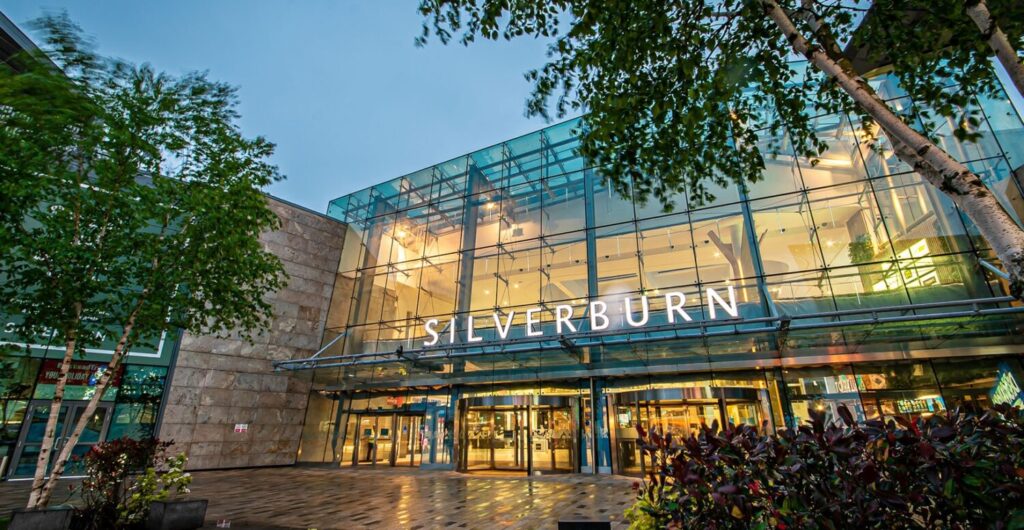
Silverburn Glasgow
Site-level performance varied considerably depending on baseline conditions and installation maturity, which itself tells a story. At Putney Exchange, IBOS identified irregular operation across AHUs, pumps and chillers, alongside signal inconsistencies and extended run times – issues that were invisible before continuous monitoring was in place. The result was a 45% reduction in energy consumption over the period. At Silverburn, deep integration across BMS, central plant, chillers, boilers, AHUs and LTHW systems delivered a 30% energy reduction – against the backdrop of a record-breaking year for footfall. At Touchwood, where IBOS’s write-back functionality enabled direct schedule changes via the BMS network, an 18% reduction was achieved within months of installation in summer 2025.
Those figures matter for obvious environmental reasons. But they really matter commercially, too. At a time when energy costs remain volatile, and occupiers are scrutinising service charge expenditure more carefully than ever, demonstrable efficiency savings are a genuine differentiator. Indeed, Touchwood’s General Manager Tony Elvin has noted that in the first quarter of 2026, footfall was up 5.1% and occupier sales up 8.9% year on year – while energy consumption fell by 19%. That combination of rising footfall and falling energy use is exactly what good building optimisation should deliver.
The potential for further adoption across the retail sector is substantial. Many shopping centres are operating BMS infrastructure that is approaching the end of its useful life, and the instinct is often to replace it wholesale. IBOS has demonstrated that intelligent integration can extend the operational lifespan of aging systems significantly while delivering immediate performance improvements – a more proportionate investment with a faster return.
The question for the sector is no longer whether building technology can work in retail, but how quickly the industry is willing to adopt it.